Skip to content




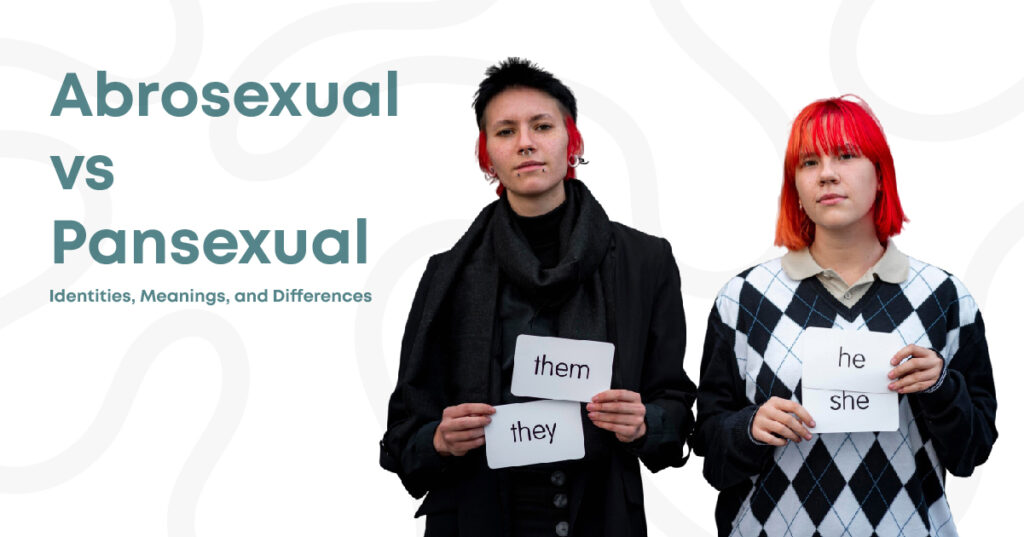
Sexuality is a continuum, constantly changing, amazingly varied, and very intimate. And with more individuals finding a language home to what is honest to their interiority, such words as abrosexual and pansexual have become critical components of the discussion. Although both identities do qualify as LGBTQ+, they define the ways in which a person feels attraction and how they identify themselves as time goes on.
We will explore the definitive definitions of these identities, their development, and draw a comparison between the arosexual and pansexual orientations in this blog, all in a compassionate, sensitive, and psychology-driven manner.
Understanding Abrosexual Identity and Meaning
Abrosexual refers to a form of sexual orientation in which the attraction of a person changes with time. It is not a matter of being lost or uncertain, it is a matter of having a dynamic and changing affair of attraction. An abrosexual person might be pansexual one month, asexual another, and bisexual another, and may feel their attraction in any combination possible. They are not able to switch identity back and forth indiscriminately, but, instead, it flows in a way that is natural to them.
Abrosexual is included in the greater continuum of fluid identities, and recognizes that not all people are always attracted to the same person.
How Abrosexual Identity Evolves Over Time
Abrosexuality is usually rhythmic or erratic in its grounds of changing attraction. Such shifts may take different periods of time (days, months, years), and they might be affected by the emotional conditions, pattern of relationships, or, in some cases, they might not be affected at all.
It is worth seeing at a glance, before we examine particular patterns, that abrosexuality does not imply that somebody has to announce every shift. Individuals merely detect the change in their experience.
Abrosexual may develop in some common ways with time, including:
- Periods of attraction where one switches between two or more orientations.
- Attractive phases with attractive and a phase of almost no attraction.
- Irregular changes, which do not follow a pattern, simply reflect the person’s mood at a particular stage of life.
Exploring Pansexual Identity and Meaning
Pansexuality can be described as a craving towards individuals irrespective of gender. It is not about being attracted to everyone, but rather recognizing that gender identity is not a defining factor in whom someone gets attracted to. A pansexual can feel attracted to men, women, non-binary, and gender-fluid individuals, as well as individuals who do not identify themselves within the gender binary.
The peculiarity of pansexuality lies in the fact that it focuses on inclusion over the entire gender spectrum. It is not day-to-day, but relatively stable, and represents a constant orientation.

Abrosexual Vs Pansexual Comparison in Attraction and Self-Labeling
Before describing differences, it is worth noting that the two identities provide language with which people can talk about attraction without judgment and pressure. The lived experience of a person has a place within each of the identities.
The following is a summary of the comparison of the abrosexual and pansexual identities.
| Aspect | Abrosexual Identity | Pansexual Identity |
| Attraction Pattern | Changes over time | Consistent across time |
| Relationship to Gender | May shift based on phase | Gender is not a factor in attraction |
| Self-Labeling | Can vary across phases | Typically steady and constant |
| Orientation Stability | Fluid | Stable |
| Core Experience | Evolving attraction | Inclusive attraction |
Key Differences and Overlaps Within the Sexuality Spectrum
The two identities lie in the same sexuality spectrum and have a few similarities, which include inclusivity and openness. They are, however, different in the way attraction is experienced and conceptualized.
It is useful first to note that both identities represent individuals who do not conform to the strict definitions of attraction before we enter into their differences.
Overlaps include:
- Both may involve attraction of both sexes.
- Both are LGBTQ+ identities.
- Both recognize attraction that is not within hetero/homo binaries.
Key differences include:
- Abrosexual entails temporal fluidity.
- Pansexuality is always uniform and universal among the genders.
- Arosexuality is sometimes similar to having multiple identities, but pansexuality is one steady identity.
Understanding Fluid Sexuality and Its Broader Context
Fluid sexuality is a broad term that acknowledges the fact that sexuality can change in certain individuals. To others, it can be constant. Such flexibility is provided by decades of psychological research in sexual identity development, such as the notion that attraction is modifiable through emotional, social, and biological factors that develop.
Fluid sexuality is not a trend or a temporary act, it is an acceptable model adopted by a large number of people in the LGBTQ+ community to explain the natural differences in human desire.
How Fluid Sexuality Connects Abrosexual and Pansexual Identities
Sexual fluidity is a mediating variable between the abrosexual and pansexual experiences – but differently. Pansexuality belongs to the category of fluid sexuality in that it denies strict confinements of gender. Arosexuality can be categorized under fluid sexuality, as it is possible to change attraction itself.
It is useful to regard fluid sexuality as a broad terrain instead of a defined category prior to pointing to the connective threads.
The two identities are allied to fluid sexuality since:
- They are broadened in conventional categories of orientation.
- They understand that attraction cannot always be categorized into a single definition.
- They enable individuals to experience attraction in a real-life situation, without feeling overwhelmed.
The Sexuality Spectrum as a Framework for Individual Exploration
The sexuality continuum offers an effective way to comprehend the fact that human attraction is not dichotomous and fixed. Rather, it identifies a palette of colorful orientations, expressions, and experiences.
Mindful of the fact that identity language ought to empower, rather than limit, self-understanding, it is essential to keep this in mind before enumerating some significant aspects of this spectrum.
Applying Psychology Ethically in Marketing: Guidance from the Mental Health Center of San Diego
Mental health practitioners always attach seriousness to ethical communication- particularly in matters of sexual or gender identities. Psychology in marketing should aim to inspire and educate people, rather than controlling emotions and perpetuating stereotypes.
Mental Health Center of San Diego upholds these principles to make sure that the discussion of identity is empathetic, encouraging, and based on respect.
If you need assistance, we will are here to help.

FAQs
What is the abrosexual meaning, and how does it relate to fluid sexuality?
Abrosexuality is said to be a sexual interest that changes. It is a form of fluid sexuality, that is, the experience of attraction changes as opposed to a fixed one.
How does the pansexual meaning reflect inclusion within the sexuality spectrum?
Pansexuality refers to the attraction of individuals of any gender. This inclusivity makes it a strong part of the sexuality continuum as an identity that reflects all gender manifestations.
What are the key differences in abrosexual vs pansexual identities?
Abrosexual people are attracted, which fluctuates with time, whereas being pansexual is being stable and embraces both sexes. The primary difference is between fluidity and consistency.
How do abrosexual vs pansexual comparisons highlight their unique identities?
A comparison of these identities reveals that abrosexuality is concerned with the changes in attraction, whereas pansexuality is concerned with gender-inclusive attraction. The two are different, but legitimate experiences.
How do the abrosexual and pansexual identities fit within the broader sexuality spectrum?
Both are placed on the sexuality scale as identities that go beyond traditional labels. They emphasize the variety and changeability of human attraction.